The €100 Million You Cannot Yet Answer For
“What did we actually know when we decided?”
Every leader knows the feeling. You are about to put your name behind a decision worth a hundred million euros. The room is waiting. And somewhere at the back of your mind sits the one question you cannot quite answer: what if I have missed the thing that matters?
You did the work. The experts reported. The numbers looked right. But the people who truly understood the detail have moved on, and their understanding left with them. The reports told you the project was busy, not whether the bet was sound. And the confident summary on your desk cannot show you how it got there.
So you sign. And you carry a quiet fear that six months from now, when something cracks, the honest answer to “what did we actually know?” will be: less than we thought.
This is not a failure of effort. Serious people did serious work. It is a failure of memory. The thinking behind the biggest decisions a company makes is treated as disposable. It is thrown away the moment the question passes, and paid for again the next time it returns.
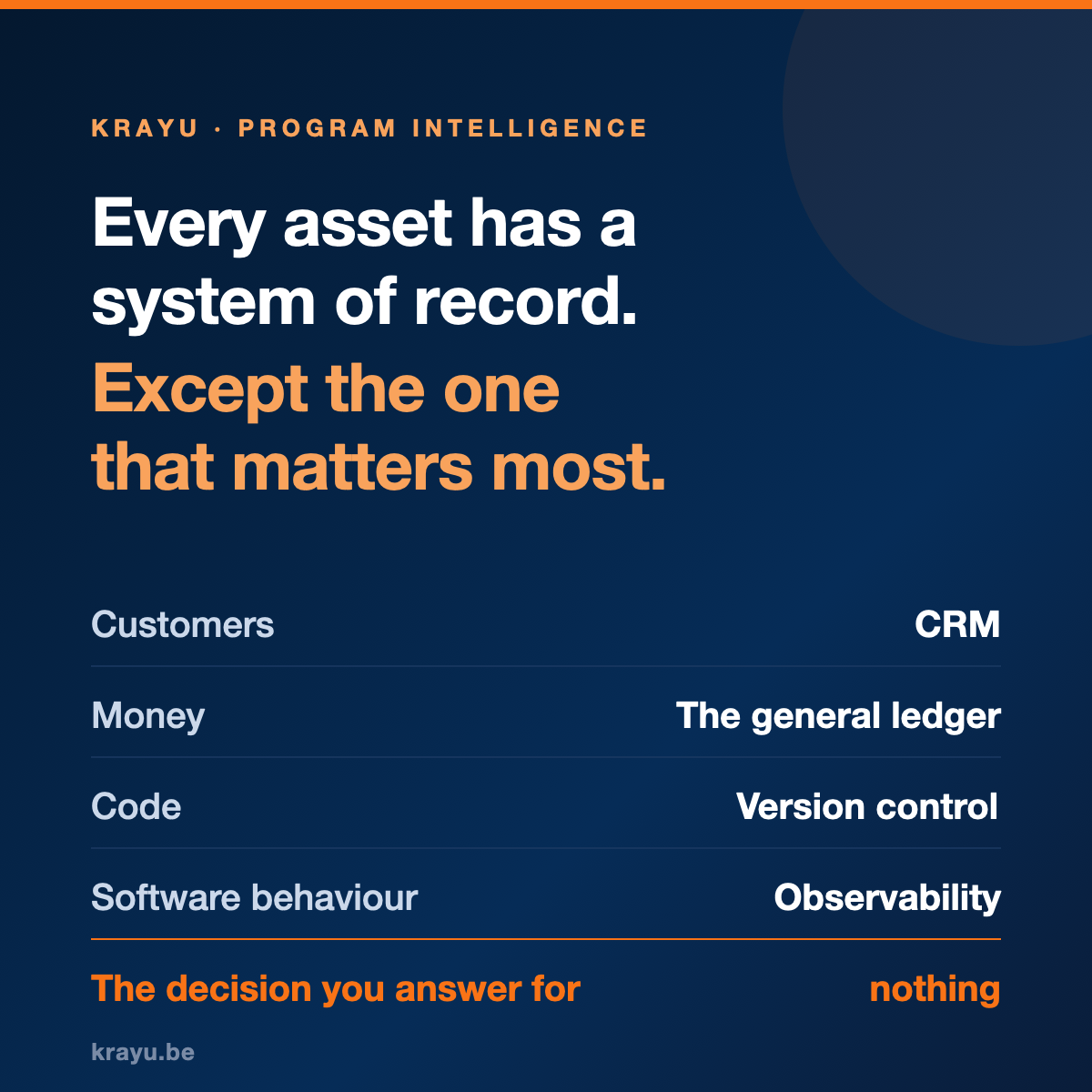
Every asset has a system of record, except the one that matters most
Look at what a company keeps track of with real care. Its customers have a system of record, and everyone knows its name. Its money has one, five hundred years old, where every euro is written down. Its code has one, where every change is kept. Even the behaviour of its software is watched around the clock.
Now look at the executive decision. The one that spends the customers, the money, and the code. The one you have to answer for, to a board, an investor, or a regulator. It has no record at all. It lives in a slide deck, in the memory of people who leave, and in the confidence of a single afternoon.
The most expensive thing in the company is the one thing nobody writes down.
A name for deciding this way
There is a name for it. Execution Blindness. It is what happens when everything on the surface looks healthy, and none of it tells you whether the thing you are about to fund will hold. The dashboards are green. The teams are busy. The reports arrive on time. And you still cannot say, with the evidence in front of you, that you are ready.
Underneath it is a quieter loss. A company gathers an enormous record of its own work, and almost none of it turns into understanding anyone can trust later. When the people who held the picture move on, the picture goes with them. So the company pays again to learn what it already knew. It is not short of information. It is short of memory it can rely on.
What is actually missing
Not another dashboard. Not a faster answer. A record. A plain, honest account of a decision that you can go back to and replay. What the evidence was. What you assumed. What could not be proven, and was left out rather than smoothed over. How sure you really were, and why.
If a company keeps a careful record of every euro it spends, it is strange that it keeps none of the decisions that spend them. The old ledger tells you where the money went. This one would tell you on what basis it was committed. Some of us have started calling that missing thing a Decision Ledger. The name matters less than the absence, which is why boards keep asking the one question no one can answer.
The question is coming
You will be asked it. Not in the room where the decision felt obvious, but later, when an assumption turns out to be incomplete and the cost arrives. What did we know when we decided, and can we show it?
Today, most leaders cannot. The experts are gone, the dashboards recorded the wrong thing, and the confident summary cannot be replayed. That is not a small inconvenience. It is the difference between a decision you can defend and one you merely made.
The work of the next decade is to close that gap, and to give the executive decision the same plain, trusted record we long ago gave to money, to code, and to customers. There is a discipline that does exactly that. It is where this series goes next.